Words of remembrance for morning and evening
All praise is due to Allah alone, and peace and blessings be upon him after whom there is no other Prophet.
Reference: Anas (RA) said that he heard the Prophet (SAW) say: "That I sit with people remembering Almighty Allah from the morning (Fajr) prayer until sunrise is more beloved to me than freeing four slaves from among the Children of Isma'il. That I sit with people remembering Allah from the afternoon ('Asr) prayer until the sun sets is more beloved to me than freeing four slaves from among the Children of Isma'il." This was reported by Abu Dawud (no. 3667). Al-Albani graded it good in SahihAbu Dawud 2/698.
أَعُوذُ بِاللهِ مِنَ الشَّيْطَانِ الرَّجِيمِ "اللهُ لَا إِلٰهَ إِلَّا هُوَ الْحَيُّ الْقَيُّومُ لَا تَأْخُذُهُ سِنَةٌ وَلَا نَوْمٌ لَهُ مَا فِي السَّمَاوَاتِ وَمَا فِي الْأَرْضِ مَنْ ذَا الَّذِي يَشْفَعُ عِنْدَهُ إِلَّا بِإِذْنِهِ يَعْلَمُ مَا بَيْنَ أَيْدِيهِمْ وَمَا خَلْفَهُمْ وَلَا يُحِيطُونَ بِشَيْءٍ مِنْ عِلْمِهِ إِلَّا بِمَا شَاءَ وَسِعَ كُرْسِيُّهُ السَّمَاوَاتِ وَالْأَرْضَ وَلَا يَئُودُهُ حِفْظُهُمَا وَهُوَ الْعَلِيُّ الْعَظِيمُ".
75. 'A 'oothu billaahi minash-Shaytaanir-rajeem. Allaahu laa 'ilaaha 'illaa Huwal-Hayyul-Qayyoom, laa ta'khuthuhu sinatun wa laa nawm, lahu maa fis-samaawaati wa maa fil-'ardh, man thai-lathee yashfa'u 'indahu 'illaa bi'ithnih, ya'lamu maa bayna 'aydeehim wa maa khalfahum, wa laa yuheetoona bishay'im-min 'ilmihi 'illaa bimaa shaa'a, wasi'a kursiyyuhus samaawaati wal'ardh, wa laa ya'ooduhu hifdhuhumaa, wa Huwal- 'Aliyyul- 'Adheem.
I seek refuge in Allah from Satan the outcast. - Allah! There is none worthy of worship but He, the Ever Living, the One Who sustains and protects all that exists. Neither slumber nor sleep overtakes Him. To Him belongs whatever is in the heavens and whatever is on the earth. Who is he that can intercede with Him except with His Permission? He knows what happens to them in this world, and what will happen to them in the Hereafter. And they will never encompass anything of His Knowledge except that which He wills. His Throne extends over the heavens and the earth, and He feels no fatigue in guarding and preserving them. And He is the Most High, the Most Great.
Reference: Whoever says this when he rises in the morning will be protected from jinns until he retires in the evening, and whoever says it when retiring in the evening will be protected from them until he rises in the morning. It was reported by Al-Hakim 1 / 562, Al-Albani graded it as authentic in Sahihut-Targhib wat-Tarhib 1/273, and traces it to An-Nasa'i and At-Tabarani. He says that At-Tabarani's chain of transmission is reliable (Jayyid).
بِسْمِ اللهِ الرَّحْمٰنِ الرَّحِيمِ "قُلْ هُوَ اللهُ أَحَدٌ ۞ اللهُ الصَّمَدُ ۞ لَمْ يَلِدْ وَلَمْ يُولَدْ ۞ وَلَمْ يَكُن لَّهُ كُفُوًا أَحَدٌ"
76. Bismillaahir-Rahmaanir-Raheem. Qul Huwallaahu 'Ahad. Allaahus-Samad. Lam yalid wa lam yoolad. Wa lam yakun lahu kufuwan 'ahad.
With the Name of Allah, the Most Gracious, the Most Merciful. Say: He is Allah (the) One. The Self-Sufficient Master, Whom all creatures need, He begets not nor was He begotten, and there is none equal to Him.
بِسْمِ اللهِ الرَّحْمٰنِ الرَّحِيمِ "قُلْ أَعُوذُ بِرَبِّ الْفَلَقِ ۞ مِن شَرِّ مَا خَلَقَ ۞ وَمِن شَرِّ غَاسِقٍ إِذَا وَقَبَ ۞ وَمِن شَرِّ النَّفّٰثَٰتِ فِي الْعُقَدِ ۞ وَمِن شَرِّ حَاسِدٍ إِذَا حَسَدَ".
Bismillaahir-Rahmaanir-Raheem. Qul 'a'oothu birabbil-falaq. Min sharri ma khalaq. Wa min sharri ghaasiqin 'ithaa waqab. Wa min sharrin-naffaathaati fil-'uqad. Wa min sharri haasidin 'ithaa hasad.
With the Name of Allah, the Most Gracious, the Most Merciful. Say: I seek refuge with (Allah) the Lord of the daybreak, from the evil of what He has created, and from the evil of the darkening (night) as it comes with its darkness, and from the evil of those who practice witchcraft when they blow in the knots, and from the evil of the envier when he envies.
بِسْمِ اللهِ الرَّحْمٰنِ الرَّحِيمِ "قُلْ أَعُوذُ بِرَبِّ النَّاسِ ۞ مَلِكِ النَّاسِ ۞ إِلَهِ النَّاسِ ۞ مِن شَرِّ الْوَسْوَاسِ الْخَنَّاسِ ۞ الَّذِي يُوَسْوِسُ فِي صُدُورِ النَّاسِ ۞ مِنَ الْجِنَّةِ وَالنَّاسِ".
Bismillaahir-Rahmaanir-Raheem. Qul 'a'oothu birabbin-naas. Malikin-naas. 'Ilaahin-naas. Min sharril-waswaasil-khannaas. Allathee yuwaswisu fee sudoorin-naas. Minal-jinnati wannaas.
With the Name of Allah , the Most Gracious , the Most Merciful. Say: I seek refuge with (Allah) the Lord of mankind, the King of mankind , the God of mankind , from the evil of the whisperer who withdraws, who whispers in the breasts of mankind, of jinns and men.
(Recite these three times each in Arabic).
Reference: Al-Ikhlas 112:1-4. - Al-Falaq 113:1-5. - An-Nas 114:1-6 - Whoever recites these three times in the morning and in the evening, they will suffice him (as a protection) against everything. The Hadith was reported by Abu Dawud 4/322, and At-Tirmithi 5/567. See Al-Albani's Sahih At-Tirmithi 3/182.
"أَصْبَحْنَا وَأَصْبَحَ الْمُلْكُ للهِ وَالْحَمْدُ للهِ، لَا إِلٰهَ إِلَّا اللهُ وَحَدْهُ لَا شَرِيكَ لَهُ، لَهُ الْمُلْكُ وَلَهُ الْحَمْدُ وَهُوَ عَلَى كُلِّ شَيْءٍ قَدِيرٌ، ربِّ أَسْأَلُكَ خَيْرَ مَا فِي هَذَا الْيَومِ وَخَيْرَ مَا بَعْدَهُ، وَأَعُوذُ بِكَ مِنْ شَرِّ مَا فِي هَذَا الْيَومِ وَشَرِّ مَا بَعْدَهُ، رَبِّ أَعُوذُ بِكَ مِنَ الْكَسَلِ، وَسُوءِ الكِبَرِ، رَبِّ أَعُوذُ بِكَ مِنْ عَذَابٍ فِي النَّارِ وَعَذَابٍ فِي الْقَبْرِ".
77. 'Asbahnaa wa 'asbahal-mulku lillaahi walhamdu lillaahi, laa 'ilaaha 'illallaahu wahdahu laa shareeka lahu, lahul-mulku wa lahul-hamdu wa Huwa 'alaa kulli shay'in Qadeer. Rabbi 'as'aluka khayra maa fee haathal-yawmi wa khayra maa ba'dahu wa 'a'oothu bika min sharri maa fee haathal-yawmi wa sharri maa ba'dahu, Rabbi 'a'oothu bika minal-kasali, wa soo'il-kibari, Rabbi 'a'oothu bika min 'athaabin fin-naari wa 'athaabin fil-qabri.
We have entered a new day 1 and with it all dominion is Allah's. Praise is to Allah. None has the right to be worshipped but Allah alone, Who has no partner. To Allah belongs the dominion, and to Him is the praise and He is Able to do all things. My Lord, I ask You for the goodness of this day and of the days that come after it, and I seek refuge in You from the evil of this day and of the days that come after it. 2 My Lord, I seek refuge in You from laziness and helpless old age. My Lord, I seek refuge in You from the punishment of Hell-fire , and from the punishment of the grave. 3
Reference:
1 When you say this in the evening you should say 'Amsaynaa wa'amsal-mulku lillaah: "We have ended another day and with it all dominion is Allah's.
2When you say this in the evening you should say: Rabbi 'as'aluka khayra maa fee haathihil-laylati, wa khayra maa ba'dahaa, wa 'a'oothu bika min sharri maa fee haathihil-laylati wa sharri maa ba'dahaa: "I ask You for the good things of this night and of the nights that come after it and I seek refuge in You from the evil of this night and of the nights that come after it."
3Muslim 4/2088.
"اللَّهُمَّ بِكَ أَصْبَحْنَا، وَبِكَ أَمْسَيْنَا، وَبِكَ نَحْيَا، وَبِكَ نَمُوتُ وَإِلَيْكَ النُّشُورُ".
78. Allaahumma bika 'asbahnaa, wa bika 'amsaynaa, wa bika nahyaa, wa bika namootu wa 'ilaykan-nushoor.
O Allah , by You we enter the morning and by You we enter the evening, 1 by You we live and and by You we die, and to You is the Final Return.2
Reference:
1 When you say this in the evening you should say: Allaahumma bika 'amsaynaa wa bika 'asbahnaa, wa bika nahyaa, wa bika namoot, wa 'ilaykal-maseer : "O Allah, You bring us the end of the day as You bring us its beginning, You bring us life and you bring us death, and to You is our fate." 2Sahih At-Tirmithi 3/142.'
"اللَّهُمَّ أَنْتَ رَبِّي لّا إِلٰهَ إِلَّا أَنْتَ، خَلَقْتَنِي وَأَنَا عَبْدُكَ، وَأَنَا عَلَى عَهْدِكَ وَوَعْدِكَ مَا اسْتَطَعْتُ، أَعُوذُ بِكَ مِنْ شَرِّ مَا صَنَعْتُ، أَبُوءُ لَكَ بِنِعْمَتِكَ عَلَيَّ، وَأَبُوءُ بِذَنْبِي فَاغْفِر لِي فَإِنَّهُ لَا يَغْفِرُ الذُّنُوبَ إِلَّا أَنْتَ".
79. Allaahumma 'Anta Rabbee laa 'ilaaha 'illaa 'Anta, khalaqtanee wa 'anaa 'abduka, wa 'anaa 'alaa 'ahdika wa wa'dika mas-tata'tu, 'a'oothu bika min sharri maa sana'tu, 'aboo'u laka bini'matika 'alayya, wa 'aboo'u bithanbee faghfir lee fa'innahu laa yaghfiruth-thunooba 'illaa 'Anta.
O Allah, You are my Lord, there is none worthy of worship but You. You created me and I am your slave. I keep Your covenant, and my pledge to You so far as I am able. I seek refuge in You from the evil of what I have done. I admit to Your blessings upon me, and I admit to my misdeeds. Forgive me, for there is none who may forgive sins but You.
Reference:
Whoever recites this with conviction in the evening and dies during that night shall enter Paradise, and whoever recites it with conviction in the morning and dies during that day shall enter Paradise, Al-Bukhari 7/150. Other reports are in An-Nasa'i and At-Tirmithi.
"اللَّهُمَّ إِنِّي أَصْبَحْتُ أُشْهِدُكَ وَأُشْهِدُ حَمَلَةَ عَرْشِكَ، وَمَلَائِكَتَكَ وَجَمِيعَ خَلْقِكَ، أَنَّكَ أَنْتَ اللهُ لَا إِلٰهَ إِلَّا أَنْتَ وَحْدَكَ لَا شَرِيكَ لَكَ، وَأَنَّ مُحَمَّداً عَبْدُكَ وَرَسُولُكَ".
80. Allaahumma 'innee 'asbahtu 'ush-hiduka wa 'ush-hidu hamalata 'arshika, wa malaa'ikataka wajamee'a khalqika, 'annaka 'Antallaahu laa 'ilaaha 'illaa 'Anta wahdaka laa shareeka laka, wa 'anna Muhammadan 'abduka wa Rasooluka.
O Allah , I have entered a new morning 1 and call upon You and upon the bearers of Your Throne , upon Your angels and all creation to bear witness that surely You are Allah , there is none worthy of worship but You alone , You have no partners, and that Muhammad is Your slave and Your Messenger . (Recite four times in Arabic.) 2
Reference:
1 When you say this in the evening you should say, Allaahumma 'innee 'amsaytu. . . .: "O Allah, I have ended another day..."
2 "Allah will spare whoever says this four times in the morning or evening from the fire of Hell, " Abu Dawud 4/317. It was also reported by Al-Bukhari in Al-'Adab Al-Mufrad, An-Nasa'i in 'Amalul-Yawm wal-Laylah and Ibn As-Sunni. Nasa'i's and Abu Dawud's chains of transmission are good (Hasan), Ibn Baz, p. 23.
"اللَّهُمَّ مَا أَصْبَحَ بِي مِنْ نِعْمَةٍ أَوْ بِأَحَدٍ مِنْ خَلْقِكَ فَمِنْكَ وَحْدَكَ لَا شَرِيكَ لَكَ، فَلَكَ الْحَمْدُ وَلَكَ الشُّكْرُ".
81. Allaahumma maa 'asbaha bee min ni'matin 'aw bi'ahadin min khalqika faminka wahdaka laa shareeka laka, falakal-hamdu wa lakash-shukru.
O Allah , whatever blessing has been received by me or anyone of Your creation 1 is from You alone , You have no partner . All praise is for you and thanks is to You. 2
Reference:
1 When you say this in the evening, you should say: Allaahumma maa 'amsaa bee...: "O Allah, as I... enter this evening..."
2 Whoever recites this in the morning, has completed his obligation to thank Allah for that day; and whoever says it in the evening, has completed his obligation for that night. Abu Dawud 4/318, An-Nasa'i 'Amalul-Yawm wal-Laylah (no. 7), Ibn As-Sunni (no. 41), Ibn Hibban (no. 2361). Its chain of transmission is good (Hasan), Ibn Baz, p. 24.
اللّهُـمَّ عافِـني في بَدَنـي ، اللّهُـمَّ عافِـني في سَمْـعي ، اللّهُـمَّ عافِـني في بَصَـري ، لا إلهَ إلاّ أَنْـتَ. (ثلاثاً)
اللّهُـمَّ إِنّـي أَعـوذُبِكَ مِنَ الْكُـفر ، وَالفَـقْر ، وَأَعـوذُبِكَ مِنْ عَذابِ القَـبْر ، لا إلهَ إلاّ أَنْـتَ . (ثلاثاً)
82. Allaahumma 'aafinee fee badanee, Allaahumma 'aafinee fee sam'ee, Allaahumma 'aafinee fee basaree, laa 'ilaaha 'illaa 'Anta (three times).
Allaahumma 'innee 'a'oothu bika minal-kufri, walfaqri, wa 'a'oothu bika min 'athaabil-qabri, laa 'ilaaha 'illaa 'Anta. (three times)
O Allah, make me healthy in my body. O Allah, preserve for me my hearing. O Allah, preserve for me my sight. There is none worthy of worship but You . (Recite three times in Arabic.)
O Allah , I seek refuge in You from disbelief and poverty and I seek refuge in You from the punishment of the grave . There is none worthy of worship but You. (Recite three times in Arabic.)
Reference:
Abu Dawud 4/324, Ahmad 5/42, An-Nasa'i, 'Amalul-Yawm wal-Laylah (no. 22), Ibn As-Sunni (no. 69), Al-Bukhari Al-'Adab Al-Mufrad. Its chain of transmission is good (Hasan), Ibn Baz, p. 26.
"حَسْبِيَ اللهُ لَآ إِلٰهَ إِلَّا هُوَ عَلَيْهِ تَوَكَّلْتُ وَهُوَ رَبُّ الْعَرْشِ الْعَظِيمِ".
83. Hasbiyallaahu laa 'ilaaha 'illaa Huwa 'alayhi tawakkaltu wa Huwa Rabbul-'Arshil-'Adheem .
Allah is sufficient for me . There is none worthy of worship but Him . I have placed my trust in Him, He is Lord of the Majestic Throne . (Recite seven times in Arabic .)
Reference:
Allah will grant whoever recites this seven times in the morning or evening whatever he desires from this world or the next, Ibn As-Sunni (no. 71), Abu Dawud 4/321. Both reports are attributed directly to the Prophet j§ (Marfu1). The chain of transmission is sound (Sahih). Ibn As-Sunni.
"اللَّهُمَّ إِنِّي أَسْأَلُكَ الْعَفْوَ وَالْعَافِيَةَ فِي الدُّنْيَا وَالْآخِرَةِ، اللَّهُمَّ إِنِّي أَسْأَلُكَ الْعَفْوَ وَالْعَافِيَةَ فِي دِينِي وَدُنْيَايَ وَأَهْللِي، وَمَالِي، اللَّهُمَّ اسْتُرْ عَوْرَاتِي، وَآمِنْ رَوْعَاتِي، اللَّهُمَّ احْفَظْنِي مِنْ بَيْنِ يَدَيَّ، وَمِنْ خَلْفِي، وَعَنْ يَمِينِي، وَعَنْ شِمَالِي، وَمِنْ فَوْقِي، وَأَعُوذُ بِعَظَمَتِكَ أَنْ أُغْتَالَ مِنْ تَحْتِي".
84. Allaahumma 'innee 'as'alukal-'afwa wal'aafiyata fid-dunyaa wal'aakhirati, Allaahumma 'innee 'as'alukal-'afwa wal'aafiyata fee deenee wa dunyaaya wa 'ahlee, wa maalee , Allaahum-mastur 'awraatee, wa 'aamin raw'aatee, Allaahum-mahfadhnee min bayni yadayya, wa min khalfee, wa 'an yameenee, wa 'an shimaalee, wa min fawqee, wa 'a'oothu bi'adhamatika 'an 'ughtaala min tahtee.
O Allah, I seek Your forgiveness and Your protection in this world and the next. O Allah, I seek Your forgiveness and Your protection in my religion, in my worldly affairs, in my family and in my wealth. O Allah, conceal my secrets and preserve me from anguish . O Allah , guard me from what is in front of me and behind me , from my left , and from my right , and from above me . I seek refuge in Your Greatness from being struck down from beneath me.
Reference:
Sahih Ibn Majah 2/332 and Abu Dawud.
"اللَّهُمَّ عَالِمَ الْغَيْبِ وَالشَّهَادَةِ فَاطِرَ السَّماوَاتِ وَالْأَرْضِ، رَبَّ كُلِّ شَيْءٍ وَمَلِيكَهُ، أَشْهَدُ أَنْ لَا إِلٰهَ إِلَّا أَنْتَ، أَعُوذُ بِكَ مِنْ شَرِّ نَفْسِي، وَمِنْ شَرِّ الشَّيْطَانِ وَشِرْكِهِ، وَأَنْ أَقْتَرِفَ عَلَى نَفْسِي سُوءاً، أَوْ أَجُرَّهُ إِلَى مُسْلِمٍ".
85. Allaahumma 'Aalimal-ghaybi wash-shahaadati faatiras-samaawaati wal'ardhi, Rabba kulli shay'in wa maleekahu, 'ash-hadu 'an laa 'ilaaha 'illaa 'Anta, 'a'oothu bika min sharri nafsee, wa min sharrish-shaytaani wa shirkihi, wa 'an 'aqtarifa 'alaa nafsee soo'an, 'aw 'ajurrahu 'ilaa Muslimin.
O Allah, Knower of the unseen and the evident , Maker of the heavens and the earth , Lord of everything and its Possessor , I bear witness that there is none worthy of worship but You . I seek refuge in You from the evil of my soul and from the evil of Satan and his helpers . (I seek refuge in You) from bringing evil upon my soul and from harming any Muslim.
Reference:
Sahih At-Tirmithi 3/142 and AbuDawud.
"بِسْمِ اللهِ الَّذِي لَا يَضُرُّ مَعَ اسْمِهِ شَيْءٌ فِي الْأَرْضِ وَلَا فِي السَّمَاءِ وَهُوَ السَّمِيعُ الْعَلِيمُ".
86. Bismillaahil-lathee laa yadhurru ma'as-mihi shay'un fil-'ardhi wa laa fis-samaa'i wa Huwas-Samee 'ul- 'Aleem .
In the Name of Allah, Who with His Name nothing can cause harm in the earth nor in the heavens, and He is the All-Hearing, the All-Knowing. (Recite three times in Arabic).
Reference:
"Whoever recites it three times in the morning will not be afflicted by any calamity before evening, and whoever recites it three times in the evening will not be overtaken by any calamity before morning." Abu Dawud 4/323, At-Tirmithi 5/465, Ibn Majah 2/332, Ahmad. Ibn Majah's chain of transmission is good (Hasan), Ibn Baz, p. 39.
"رَضِيتُ باللهِ رَبَّاً، وَبِالْإِسْلَامِ دِيناً، وَبِمُحَمَّدٍ صَلَى اللهُ عَلِيهِ وَسَلَّمَ نَبِيَّاً".
87. Radheetu billaahi Rabban, wa bil-'Islaami deenan, wa bi-Muhammadin (sallallaahu 'alayhi wa sallama) Nabiyyan.
I am pleased with Allah as my Lord, with Islam as my religion and with Muhammad (peace and blessings of Allah be upon him) as my Prophet. (Recite three times in Arabic .)
Reference:
"Allah has promised that anyone who says this three times every morning or evening will be pleased on the Day of Resurrection." Ahmad 4/ 337, An-Nasa'i, 'Amalul-Yawm wal-Laylah p. 4, Ibn As-Sunni (no. 68), At-Tirmithi 5/465. Its chain of transmission is good (Hasan), Ibn Baz, p. 39.
"يَا حَيُّ يَا قَيُّومُ بِرَحْمَتِكَ أَسْتَغِيثُ أَصْلِحْ لِي شَأْنِي كُلَّهُ وَلَا تَكِلْنِي إِلَى نَفْسِي طَرْفَةَ عَيْنٍ".
88. Yaa Hayyu yaa Qayyoomu birahmatika 'astagheethu 'aslih lee sha'nee kullahu wa laa takilnee 'ilaa nafsee tarfata 'aynin.
O Ever Living One, O Eternal One, by Your mercy I call on You to set right all my affairs. Do not place me in charge of my soul even for the blinking of an eye (i.e. a moment).
Reference:
Its chain of transmission is sound (Sahih), Al-Hakim 1/545, see Albani, Sahihut-Targhib wat-Tarhib, 1/273.
89. 'Asbahnaa wa 'asbahal-mulku lillaahi Rabbil-'aalameen, Allaahumma 'innee 'as'aluka khayra haathal-yawmi: Fathahu wa nasrahu wa noorahu, wa barakatahu, wa hudaahu, wa'a'oothu bika min sharri maafeehi wa sharri maa ba'dahu.
We have entered a new day and with it all the dominion which belongs to Allah, Lord of all that exists. O Allah, I ask You for the goodness of this day,2 its victory, its help, its light, its blessings, and its guidance. I seek refuge in You from the evil that is in it and from the evil that follows it.
Reference:
1 For evening recitation, say here: Allaahumma 'innee 'as'aluka khayra haathihil-laylati: "My Lord, I ask You for the good things of this night."
2 Abu Dawud 4/322. Its transmission chain is good (Hasan). See also Ibn Al-Qayyim, Zadul- Ma'ad 2/273.
"أَصْبَحْنَا عَلَى فِطْرَةِ الْإِسْلَامِ وَعَلَى كَلِمَةِ الْإِخْلَاصِ، وَعَلَى دِينِ نَبِيِّنَا مُحَمَّدٍ صَلَى اللهُ عَلِيهِ وَسَلَّمَ، وَعَلَى مِلَّةِ أَبِينَا إِبْرَاهِيمَ، حَنِيفَاً مُسْلِماً وَمَا كَانَ مِنَ الْمُشْرِكِينَ".
90. 'Asbahnaa 'alaa fitratil-'Islaami wa 'alaa kalimatil-'ikhlaasi, wa 'alaa deeni Nabiyyinaa Muhammadin (sallallaahu 'alayhi wa sallama), wa 'alaa millati 'abeenaa 'Ibraaheema, haneefan Musliman wa maa kaana minal-mushrikeen.
We have entered a new day 1 upon the natural religion of Islam, the word of sincere devotion, the religion of our Prophet Muhammad (peace and blessings of Allah be upon him), and the faith of our father Ibrahim. He was upright (in worshipping Allah), and a Muslim. He was not of those who worship others besides Allah. 2
Reference:
1 When you say this in the evening, you should say: 'Amsaynaa 'alaa fitratil-'Islaam...: "We end this day..."
2 Ahmad 3/406-7, 5/123, An-Nasa'i, 'Amalul- Yawm wal-Laylah (no. 34), At-Tirmithi 4/209.
"سُبْحَانَ اللهِ وَبِحَمْدِهِ".
91. Subhaanallaahi wa bihamdihi.
Glory is to Allah and praise is to Him. (Recite one hundred times in Arabic ).
Reference:
"Whoever recites this one hundred times in the morning and in the evening will not be surpassed on the Day of Resurrection by anyone having done better than this except for someone who had recited it more. " Al-Bukhari 4/2071.
"لَا إِلٰهَ إِلَّا اللهُ وَحْدَهُ لَا شَرِيكَ لَهُ، لَهُ الْمُلْكُ وَلَهُ الْحَمْدُ، وَهُوَ عَلَى كُلِّ شَيْءٍ قَدِيرٌ".
92,93. Laa 'ilaaha 'illallaahu wahdahu laa shareeka lahu, lahul-mulku wa lahul-hamdu, wa Huwa 'alaa kulli shay'in Qadeer.
None has the right to be worshipped but Allah alone, Who has no partner. His is the dominion and His is the praise and He is Able to do all things . (Recite ten times 1 in Arabic or one time to ward off laziness.)2
Reference:
1Allah will write ten Hasanaat (rewards) for whoever recites this ten times in the morning, and forgive him ten misdeeds and give him the reward of freeing ten slaves and protect him from Satan. Whoever recites this ten times in the evening will get this same reward. An-Nasa'i, 'Amalul-Yawm wal-Laylah (no. 24). Its chain of transmission is sound (Sahih). Albani 1/272. Abu Hurayrah «fe narrated that the Prophet j§ said: "Allah will write one hundred Hasanat for whoever says There is no God but Allah alone, He has no partner. To Allah is possession of everything, and to Him all praise is. He is Capable of all things' ten times in the morning, and forgive him one hundred misdeeds. He will have the reward of freeing a slave and will be protected from Satan throughout the day unto dusk. Whoever says it in the evening will have the same reward." Ahmad 8/704, 16/293. Its chain of transmission is good (Hasan), Ibn Baz, p. 44.
2 Whoever recites this in the morning, will have the reward of freeing a slave from the Children of Isma'il. Ten Hasanaat (rewards) will be written for him, and he will be forgiven ten misdeeds, raised up ten degrees, and be protected from Satan until evening. Whoever says it in the evening will have the same reward until morning. Abu Dawud 4/319, 3/957, Ahmad 4/ 60, Ibn Majah 2/331, Ibn Al-Qayyim Zadul-Ma'ad 2/388. Its chain of transmission is sound (Sahih). Al-Albani 1/270.
"سُبْحَانَ اللهِ وَبِحَمْدِهِ: عَدَدَ خَلْقِهِ، وَرِضَا نَفْسِهِ، وَزِنَةَ عَرْشِهِ وَمِدَادَ كَلِمَاتِهِ".
95. Subhaanallaahi wa bihamdihi: 'Adada khalqihi, wa ridhaa nafsihi, wa zinata 'arshihi wa midaada kalimaatihi.
Glory is to Allah and praise is to Him, by the multitude of His creation, by His Pleasure, by the weight of His Throne, and by the extent of His Words. (Recite three times in Arabic upon rising in the morning .)
Reference:
Muslim 4/2090.
"اللَّهُمَّ إنِّي أَسْأَلُكَ عِلْماً نَافِعاً، وَرِزقاً طَيِّباً، وَعَمَلاً مُتَقَبَّلاً".
96. Allaahumma 'innee 'as'aluka 'ilman naafi'an, wa rizqan tayyiban, wa 'amalan mutaqabbalan.
O Allah, I ask You for knowledge that is of benefit , a good provision , and deeds that will be accepted . (Recite in Arabic upon rising in the morning.)
Reference:
Ibn As-Sunni, no. 54, Ibn Majah no. 925. Its chain of transmission is good (Hasan), Ibn Al-Qayyim 2/375.
"أَسْتَغْفِرُ اللهَ وَأَتُوبُ إِلَيْهِ".
97. 'Astaghfirullaaha wa 'atoobu 'ilayhi.
I seek the forgiveness of Allah and repent to Him. (Recite one hundred times in Arabic during the day .)
Reference:
Al-Bukhari, cf. Al-Asqalani, Fathul-Bari 11/101, Muslim 4/2075.
"أَعُوذُ بِكَلِمَاتِ اللهِ التَّامَّاتِ مِنْ شَرِّ مَا خَلَقَ".
98. 'A'oothu bikalimaatil-laahit-taammaati min sharri maa khalaqa.
I seek refuge in the Perfect Words of Allah from the evil of what He has created. (Recite three times in Arabic in the evening .)
Reference:
Whoever recites this three times in the evening will be protected from insect stings, Ahmad 2/ 290, An-Nasa'i, 'Amalul-Yawm wal-Laylah no. 590, At-Tirmithi 3/187, Ibn As-Sunni no. 68. According to Al-Albani, Ibn Majah's (2/266) chain of transmission is sound (Sahih), and following Ibn Baz 45, At-Tirmithi's report is good (Hasan).
"اللَّهُمَّ صَلِّ وَسَلِّمْ عَلَى نَبِيِّنَا مُحَمَّدٍ".
99. Allahumma salli wa sallim 'alaa nabiyyinaa Muhammadin
Oh Allah, we ask you for peace and blessings upon our prophet Muhammad (Recite ten times in Arabic)
Reference:
The prophet (peace be upon him) said: "Who recites blessings upon me 10 times in the morning and 10 times in the evening will obtain my intercession on the Day of Resurrection." At-Tabrani reported this Hadith together with two chain of transmissions. One of them is reliable (Jayyid). See Haithami's Majma' Az-Zawa'id 10/120, and Al-Albani's Sahih At-Targhib Wat-Tarhib 1/273


|
REWARDS FOR DUAS.jpg Size : 266.829 Kb Type : jpg |
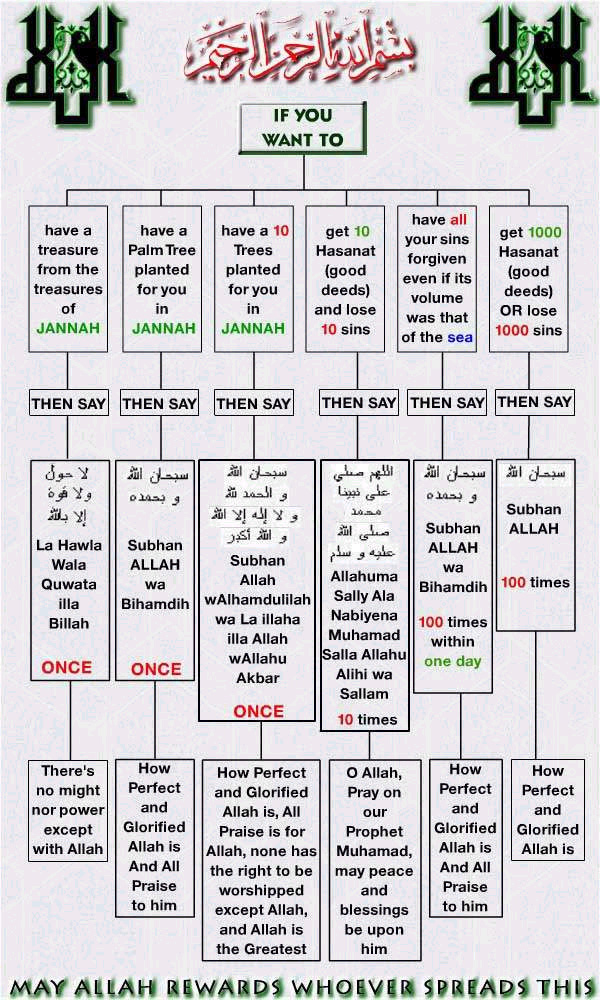
Download and print the above file if you want.Practice to repeat them frequently.
Juwairiyah bint Al-Harith (May Allah be pleased with her) reported, the Mother of the Believers: The Prophet (PBUH) came out from my apartment in the morning as I was busy in performing the dawn prayer. He came back in the forenoon and found me sitting there. The Prophet (PBUH) said, “Are you still in the same position as I left you.” I replied in the affirmative. Thereupon the Prophet said, “I recited four words three times after I had left you. If these are to be weighed against all you have recited since morning, these will be heavier. These are: Subhan-Allahi wa bihamdihi, `adada khalqihi, wa rida nafsihi, wa zinatah `arshihi, wa midada kalimatihi [Allah is free from imperfection and I begin with His praise, as many times as the number of His creatures, in accordance with His Good Pleasure, equal to the weight of His Throne and equal to the ink that may be used in recording the words (for His Praise)].”[Sahih Muslim].
Commentary: The recitation of the words quoted in this Hadith is highly meritorious and rewarding because they are full of Praise and Glorification of Allah.
Easy Zikr which is light on the tongue but heavy on the scales!
1. Earn a thousand good deeds in Minutes:Prophet Muhammad (Peace be upon him) said: "Is anyone of you incapable of earning one thousand Hasanah (rewards) a day?" Someone from the gathering asked, "How can anyone of us earn a thousand Hasanah?" Prophet Muhammad (Peace be upon him) said: "Glorify Allah a hundred times by just saying "Subhanallah" and a Good deeds will be written for you, or a thousand sins will be wiped away." (Muslim 4:2073)
2. One of the Rare Treasures of Paradise:
Hadhrat Abu Dharr (Ra) narrated that Rasulallah (Saw) said: "Should I not tell you of one treasure of the unlimited treasures of Paradise?" I replied spontaneously "Oh Rasulallah (Peace be upon him) that would be an honour indeed!" Rasulallah (sal-lal-lahu alai hi wa sallam) said: "That rare treasure is LA HAWLA WA LA QUWWATA ILLA BILLAH." ("The strength to do good and to refrain from evil comes from the grace and mercy of Allah!") -(Ibn Majah) Hadrat Abu Dharr al-Ghifari (may Allah be pleased with him) narrates that "my beloved friend" (the Holy Prophet Muhammad, may Allah's blessings and peace be upon him) has enjoined five things upon me. He has commanded me to love and be close to the poor and the downtrodden, and he has commanded me to look at those in the world who are of lower rank than me, and not at those who are of higher rank, and he has commanded me to be kind to the kinsman and to preserve and keep intact the bond of kinship, and he has commanded me not to ask for anything from anyone as a favour and he has commanded me to speak the truth at all times though it may be bitter for others, and he has commanded me to care nothing for the rebuke of those who revile and villify in the path of Allah, and he has commanded me to recite much the Kalima of: Laa Hawla wa laa Qawwuta Illaa Billah (there is no power or strength but in Allah) because all these things are from the treasure-house (of Allah) which is under the ninth heaven. (Ahmad) .
3. A Date Palm planted in Paradise for the one who recites this:
Hadhrat Jaa'bir (Ra) narrated that Rasulallah(Peace be upon him) said: "For the person who recites SUB-HAN'ALLAH HIL AZEEM WA BI-HAM'DIHI, [Pure and perfect is Allah in his glory and praise], - A date palm will be planted for him in Paradise" (Tirmidhi) Another Narration says: Forgiveness for Sins Even Though they are like the Foam of the Sea: Narrated Abu Huraira: Allah’s Apostle said, "Whoever says, ‘Subhan Allaahi Wa bihamdihi, {Allah is free from imperfection and His is the praise}. One hundred times a day, will be forgiven all his sins even if they were as much as the foam of the sea. (Bukhari, Book #75, Hadith #414) .
4. We Can Earn Over a BILLION Rewards in Just a Few Seconds!Narrated ‘Ubaadah that the Messenger of Allah said, "Whoever seeks forgiveness for the believing men and believing women, Allah will write for him a good deed for each believing man and believing woman." (Tabarrani)
5. That Which Shall Have no Equal on the Day of Resurrection: Narrated Abu Huraira:Allah’s Apostle said, "Whoever says one hundred times in a day: "Laa ilaaha illallaah wahdahuu laa shareeka lahu, lahu-l-mulk wa lahu-l-hamd wa huwa ‘alaa kulli shai’in qadeer," ("None has the right to be worshipped but Allah, the Alone Who has no partners, to Him belongs Dominion and to Him belong all the Praises, and He has power over all things (i.e. Omnipotent)",} he will get the same reward as given for manumitting ten slaves; and one hundred good deeds will be written in his accounts, and one hundred sins will be deducted from his accounts, and it (his saying) will be a shield for him from Satan on that day till night, and nobody will be able to do a better deed except the one who does more than he." (Bukhari, Book #75, Hadith #412)
6. Four Phrases that are Heavier on the Scales than an Entire Morning of Dhikrullah (Remembrance of Allah):
The Mother of the Believers, Juwairiyah bint Al-Harith reported that the Prophet came out from my apartment in the morning as I was busy in performing the dawn prayer. He came back in the forenoon and found me sitting there. The Prophet said, "Are you still in the same position as I left you." I replied in the affirmative. Thereupon the Prophet said, "I recited four phrases three times after I had left you. If these are to be weighed against all you have recited since morning, these will be heavier. These are:Subhan-Allah Wa bihamdihi, ‘adada khalqihi, wa rida-a nafsihi, wa zinatah ‘arshihi, wa midada kalimatihi (Allah is free from imperfection and I begin with His praise, as many times as the number of His creatures, in accordance with His Good Pleasure, equal to the ink that may be used in recording the words (for His Praise)." (Muslim)
7. A Phrase that Comes with Rewards in the MILLIONS:
On the authority of Abdullah ibn ‘Umar that the Prophet said: "Whoever enters a market and says: ‘Laa ilaaha ill Allah Wahdahu laa shareeka lah, lahul Mulku Wa lahul Hamdu yuhyi Wa yumeetu
‘Wa huwa Hayyun laa yamoot, bi yadihil khayr, wahuwa ‘alaa kulli shay’ in qadeer’ {There is nothing worthy of worship but Allah, He is alone without partner, to Him belongs the dominion and the praise, he causes life and death and He is the Living One and will never die. In His Hand is all good, and He is over all things capable.) Allah will write for him a million good deeds erase a million of his bad deeds and build for him a house in Jannah." And in another narration, instead of mentioning that Allah will build a house in Jannah, it states, "and he will be raised one million levels." (Tirmidhi).
8. Reciting Tasbeeh, (Subhanballah), Tahmeed (Alhamdolillah) and Takbeer Allahu Akbar) and enjoining what is Good and forbidding what is evil and praying Salaatul Duha (Breakfast prayer): It was narrated from Abu Dharr that the Prophet (peace and blessings of Allaah be upon him) said: "For every bone of the son of Adam a charity must be given each day. Every Tasbeehah (saying Subhaan Allah -Glory be to Allah) is a charity, every Tahmeedah (saying Al-hamdu Lillaah -praise be to Allah) is a charity, every tahleelah (saying Laa ilaaha ill-Allah -There is no god but Allah) is a charity, every takbeerah (saying Allaahu akbar -Allah is Most Great) is a charity, enjoining what is good is a charity, forbidding what is evil is a charity, and two Rak’ahs (Nafil) offered in the mid-morning (Duha) is sufficient." (Muslim, 720)
9. The Virtues of Reciting Tasbih at-I-Fatima: A well-known Tradition of the Prophet (Peace be upon him) has it that the Prophet's beloved daughter (and Hazrat Ali's (Ra) wife), Hazrat Fatima (Ra), used to perform all the domestic duties with her own hands. She had even to draw water from the well and to carry it home and to grind the corn in the millstone. One day she begged the holy Prophet (Peace be upon him) to provide her with a domestic servant upon which the Prophet (Peace be upon him) observed, "I will tell you of something that will serve you better than a domestic servant. Recite Subhaa-nallaah 33 times, Alhamdu lillaah 33 times, and Allahu Akbar 34 times after each Salaah and on retiring to bed. This will be of greater value to you than a servant." Another Tradition says, "Whoever will recite after each Salaah 33 times Subhaa-nallaah, 33 times Alhamdu lillaah, and 34 times Allahu Akbar and at the end of it, the Kalima of: 'Laa ilaaha illal laahu wahdahu laa sharika lahu lahul mulku wa-lahul hamdu wa huwa alaa kulli shay-in qadeer’.
(There is no Allah but one Allah. He is alone. No partner hath. He Him belongs sovereignty and unto Him belongs Praise and He is all-Powerful) all his sins will be forgiven even if they be as profuse as the foam of the sea."
10. How to Erase 2500 Sins in 5 minutesAbd-Allaah ibn ‘Amr (may Allah be pleased with him) who said: "The Messenger of Allah (peace be upon him) said: ‘There are two qualities, no Muslim man acquires them but he will enter Paradise, and they are simple and easy. He should glorify Allah (say Subhaan Allah) ten times immediately after each prayer, and praise Him (say Al-hamdu Lillaah) ten times and magnify Him (say Allaahu Akbar) ten times.’ I saw the Messenger of Allah (peace and blessings of Allah be upon him) counting this on his fingers. He said: ‘That makes one hundred and fifty on the tongue and one thousand five hundred (hasanaat) in the scales. *Translator’s note: each of three phrases repeated ten times makes thirty; multiplied by the number of daily prayers, which is five, makes one hundred and fifty. Each of these good deeds of the tongue will be rewarded with ten hasanaat which will be added to the total of good deeds to be weighed in the balance or scales on the Day of Judgement].
11. Glorifying Allah 100 times when one goes to bed: When you go to bed, glorify Him and praise Him and magnify Him One hundred times: that will be one hundred on the tongue and a thousand in the scales. Who among you does 2,500 bad deeds in one day?’ They said: ‘How could we not count (our sins)?’ He said: ‘The Shaytaan comes to any one of you whilst he is praying and says, Remember this, remember that, until he finishes his prayer and does not do (this dhikr), or he comes to him when he is lying down and makes him sleepy, until he falls asleep (without doing this dhikr).’" (Sunan al-Tirmidhi, 3332).
12. Earning a 1000 good deeds and wiping away a 1000 bad deeds in Minutes: If a person says "Subhanallah" (glory be to Allah) 100 times, a thousand good deeds are recorded for him and a thousand bad deeds are wiped away. (Muslim)
13. Jannat becomes obligatory for the one who recites the following: Abu Sa’id (Ra) said that Rasullallah (Peace be upon him) said, "Whoever says: Radeetu billahi rabban, Wa bil-Islaami deenan, Wa bi-Muhammadin rasoolan Jannah becomes obligatory for him (to enter). (Abu-Dawud) - Best said in Morning and Evening with "Nabiyan wa rasoolan"
14. The Virtues of Reciting the First Kalimah: The declaration of belief in the oneness of Allah or kalimah tayyibah Laa ilaaha ill-Allah . (There is no worthy of worship except Allah) This should be read as much as possible all the time where we are and whatever were doing as long as it is not in the toilet.
Hadrat Zaid bin ‘Arqam (Allah be pleased with him) narrated that the Messenger of Allah (peace be upon him) said: "Whoever says Laa ilaaha illal-laah…sincerely will enter the Paradise." It was said: And what is the [sign of] sincerity? He said: "That this kalimah stops him from those things which Allah has forbidden." (Tabaraani in Awsat-ul-Kabeer) "Do you not see how Allah puts forth the likeness of a good word (kalimah tayyibah)? It is like a good tree, whose root is firmly fixed and whose branches reach to the sky. It brings forth its fruit in all seasons by the command of its Lord. And Allah sets forth parables for men, so that they may take heed. And the likeness of an evil word (kalimah khabeetha- a word of shirk) is like an evil tree, which is uprooted from the face of the earth, and has no stability." (Qur’an: 24-26)
15. Virtues of Reciting the Third Kalimah: The word of glorification or the Kalima-e-Tamjeed Subhāna-llāhi, wa-l-hamdu li-llāhi, Wa lā ilāha illā-llāhu, wa-llāhu akbar. Wa lā hawla Wa lā quwwata illā bi-llāhi-l-‘aliyyi-l-‘azīm . (Glory be to Allah. And praise be to Allah. And there is no god except Allah. And Allah is the Greatest. And there is no power and no strength except with Allah, the Most High, And Most Great)
Ibn Mas’ood (Allah be pleased with him) narrated that the Messenger of Allah (peace be upon him) said: "When I met Prophet Ibrahim (peace be upon him) in the night of Mi’raaj (Night of ascension) he asked me to convey his Salaam to my Ummah and to tell them that the Paradise has a fertile soil and sweet water, and is like a vast field. And its plants are *the words above+." Another version says: "Whoever recites the words above, a tree in Paradise is planted for him for each word he says." (Virtues of Dhikr; Tirmidhi)
16. Virtues of reading the Fourth Kalimah:
The word of Oneness of Allah or the Kalima-e-Tawhid: Lā ilāha illā-llāhu waḥdahu lā sharīka lahu lahu-l-mulku Wa lahu-l-hamdu yuḥyi Wa yumītu Wa huwa ḥayyu-llā yamūtu abadan abada, ḏū-l-jalāli wa-l-
ikrām, biyadihi-l-khayr, wa huwa ‘alā kulli Shay’in qadīr. (There is no god except Allah, Who is Alone and has no partners. For Him is the Dominion and for Him is all praise. He gives life and causes death. And He is living and will never ever die. Owner of Majesty and Honour: In His Hands is all goodness. And He has power over all things). Abu Hurairah (Allah be pleased with him) reports that the Messenger of Allah (peace be upon him) said: "A person who recites: Laa ilaaha illal-laahu wahdahu laa shareeka lahu, lahul-mulku wa lahul-hamdu wa huwa ‘alaa kulli shay-in qadeer, a hundred times daily will have reward equal to that of freeing ten slaves and one hundred good deeds will be written for him, and one hundred of his sins will be lifted from him, and for the whole day, he will remain immune from the Shaytaan until the evening, and on the Day of Judgment, no one will exceed him in merit except one who has done *these phrases+ more." (Agreed Upon)
Here are the virtues of Qur'an and some recommended Surah's:
17. Reward for Reciting each letter of Holy Qur’aan:
It was narrated that ‘Abd-Allaah ibn Mas’ood said: The Messenger of Allah (peace and blessings of Allah be upon him) said: "Whoever reads a letter of the Book of Allah will be credited with a good deed, and a good deed gets a tenfold reward. I do not say that Alif-Laam-Meem is a letter, rather alif is a letter, laam is a letter and meem is a letter." (Narrated by al-Tirmidhi, 2910)
18. Surah Fathiha The Mother of the Qur’an and a cure for every disease: Abu Sulaiman says that once a group of Companions were in an expedition (ghazwa) when they happened to come across an epileptic person, who was unconscious. One of the Companions recited Surah Al-Fatiha and blew in his ear. The epileptic person immediately cured. When Sayyidana Muhammad (Peace be upon him) was informed of this, he said: "It (Surah Al-Fathiha) is "The Mother of the Qur’an" (Umm al-Qur’an) and is a cure for every disease." [This narration has been recorded by Ath-Thua’lbi from Abu Sulaiman, who narrated it from Muawiya bin Saleh (RA), Tafseer Mazhari 1:31]
19. Surah Mulk which protects one from the Torment of the Grave: It was narrated that Abdullah ibn Mas’ud said: Whoever reads Tabarakallahi Biyadihil Mulk [i.e. Surah al-Mulk] every night, Allah will protect him from the torment of the grave. At the time of the Messenger of Allah (Peace be upon him) we used to call it al-mani’ah (that which protects). In the Book of Allah it is a surah which, whoever recites it every night has done very well. (an-Nasa’i)
20. Surah Zilzalah worth half of the Qur’an:
Abdullah Ibn ‘Abbas and Anas Ibn Malik (Ra) reported that the Prophet (Peace be upon him) said, ‘Whoever recited Surah Zilzilah (99) would get the reward of reciting half the Qur’an. Whoever recited Surah al Kaafirun (109) would get a reward as if reading a quarter of the Qur’an. Whoever recited Surah al Ikhlas (112)would get a reward as if reading one third of the Qur’an’. (At-Tirmidhi 2818/A) 21. Surah Iklhas worth a third of the Qur’an : Abu Sa’id al-Khudri (RA) reported that the Messenger of Allah (Peace be upon him) said to his Companions, "Are any of you unable to recite a third of the Qur’an in a night?" That was difficult for them and they said, "Which of us is able to do that, Messenger of Allah?" He said, "*The surah+ ‘Say: He is Allah, Absolute Oneness, Allah, the Everlasting Sustainer of all’ (112) constitutes a third of the Qur’an.’" (Sahih al-Bukhari 6:61 #534, Riyad as-Salihin by Imam an-Nawawi Ch.183 #1010)
22. Surah Iklhas recited 200 times daily gets forgiveness of 50 years of sin: Anas ( RA) reported the Prophet (Peace be upon him) as saying, "If anyone recites two hundred times daily, Qul huwallahu ahad the sins of fifty years will be wiped out, unless he is in debt." (At-Tirmidhi and Darami). The latter version has ‘fifty times’ and he did not mention ‘unless he is in debt’ .
23. Surah al Falaq and An Naas protection from Jinn and evil eye: The Prophet (Peace be upon him) used to seek refuge from the jinn as well as from the evil eye until Surah al Falaq and An Naas were revealed. When they were sent down, he utilised them and left other things. [At-Tirmidhi #1984, Riyad as-Salihin by Imam an-Nawawi Ch.183 #1014]
24. Good manners are the Heaviest on the good deed scales: Abu Darda (May Allah be pleased with him) reported: The Prophet (Peace be upon him) said, "Nothing will be heavier on the Day of Resurrection in the Scale of the believer than good manners. Allah hates one who utters foul or coarse language.'' So let us be the best towards others and be humble! Let us also remember Allah as much as we can!
25. We will regret the Seconds we wasted without remembering Allah:
Hadhrat Mu'az *RA+ narrated Rasulallah (Peace be upon him) said: "The Inhabitants of Paradise will not be grief stricken or sorrowful about anything they did in the life of the world except for the time they spent without being in the remembrance of Allah". (Tabaraani)
26. Do Dhikr of Allah even if its on Comfortable beds: Hadhrat Abu Saeed Khudri (Ra) narrates that Rasulullah (Peace be upon him) said: "There are many people reclining on comfortable beds and making the Dhikr of Allah on earth. Allah will grant them elevated ranks (in the Aakhirah)." (Ibn Habbaan) Those indulging in luxury should not abstain from Dhikrullah. They too should be constantly engaged in the remembrance of Allah whilst enjoying the comforts of the bounties which whilst enjoying the comforts of the bounties which Allah has bestowed on them and Allah will give them elevated ranks in the hereafter.
27. Do so much Dhikr that people think your mad: Hadhrat Abu Saeed Khurdi (Ra) also narrates that Rasulullah (Peace be upon him) said: "Engage in the Dhikr of Allah in such abundance that people comment that ‘you are insane’." (Ahmed, Abu Ya’la, Ibn Habbaan)
28. Remember Allah in the places where people don’t usually remember Allah: It is mentioned in hadith that in a place where people are oblivious to dhikir, remembrance of Allah is like being steadfast in jihad, when others are running away. (Targhib, p. 193, vol. 3 ref. Bazar and Tibrani)
| The Excellence of the Remembrance of Allah
Allah, the Exalted, says: "And the remembering (praising) of (you by) Allah (in front of the angels) is greater indeed [than your remembering (praising) of Allah in prayers]'' (29:45) "Therefore remember Me (by praying, glorifying). I will remember you.'' (2:152) "And remember your Rubb by your tongue and within yourself, humbly and with fear and without loudness in words, in the mornings and in the afternoons, and be not of those who are neglectful.'' (7:205) "And remember Allah much, that you may be successful.'' (62:10) "Verily, the Muslims (those who submit to Allah in Islam) men and women... (up to)... And the men and the women who remember Allah much with their hearts and tongues. Allah has prepared for them forgiveness and a great reward (i.e., Jannah).'' (33:35) "O you who believe! Remember Allah with much remembrance. And glorify His Praises morning and afternoon [the early morning (Fajr) and `Asr prayers].'' (33:41,42)
1408. Abu Hurairah (May Allah be pleased with him) reported: The Messenger of Allah (PBUH) said, "There are two statements that are light for the tongue to remember, heavy in the Scales and are dear to the Merciful: `Subhan-Allahi wa bihamdihi, Subhan-Allahil-Azim [Glory be to Allah and His is the praise, (and) Allah, the Greatest is free from imperfection)'.'' Commentary: This Hadith affirms that man's actions carry weight. On the Day of Judgement, his actions will be cast into the Balance. At that time Allah will endow these actions with weight, or according to some scholars, those records which register man's actions will be weighed. This is quite possible for the reason that Almighty Allah is Capable of weighing things without even their physical form. This discussion apart, when actions will be cast into the Balance, the formula mentioned in the Hadith, the utterance of which is very easy, will prove weighty. Every Muslim should make it a practice to repeat them frequently.
1409. Abu Hurairah (May Allah be pleased with him) reported: The Messenger of Allah (PBUH) said, "The uttering of the words: "Subhan-Allah (Allah is free from imperfection), Al-hamdu lillah (all praise is due to Allah), La ilaha illallah (there is no true god except Allah) and Allahu Akbar (Allah is the Greatest)' is dearer to me than anything over which the sun rises.'' Commentary: This Hadith hightlights the fact that the formulas which mention the Praise and Glory of Allah, His Majesty and Oneness are liked by the Prophet (PBUH) more than anything in the world, because this is one of the virtues which will survive and will be rewarded, while the world and all that it has will perish.
1410. Abu Hurairah (May Allah be pleased with him) reported: The Messenger of Allah (PBUH) said, "He who utters a hundred times in a day these words: `La ilaha illallahu, wahdahu la sharika lahu, lahul-mulku wa lahul-hamdu, wa Huwa `ala kulli sha'in Qadir (there is no true god except Allah. He is One and He has no partner with Him; His is the sovereignty and His is the praise, and He is Omnipotent),' he will have a reward equivalent to that for emancipating ten slaves, a hundred good deeds will be recorded to his credit, hundred of his sins will be blotted out from his scroll, and he will be safeguarded against the devil on that day till the evening; and no one will exceed him in doing more excellent good deeds except someone who has recited these words more often than him. And he who utters: `Subhan-Allahi wa bihamdihi (Allah is free from imperfection and His is the praise)' one hundred times a day, his sins will be obliterated even if they are equal to the extent of the foam of the ocean.'' Commentary: Here sins mean minor sins and those which do not relate to the rights of people. This point has already been elaborated in the preceding Ahadith.
1411. Abu Ayyub Al-Ansari (May Allah be pleased with him) reported: The Prophet (PBUH) said: "He who utters ten times: `La ilaha illallahu, wahdahu la sharika lahu, lahulmulku wa lahulhamdu, wa Huwa `ala kulli sha'in Qadir (there is no true god except Allah. He is One and He has no partner with Him. His is the sovereignty and His is the praise, and He is Omnipotent),' he will have a reward equal to that for freeing four slaves from the progeny of Prophet Isma`il.'' Commentary: "Slaves from the progeny of Isma`il'' is a simile for very precious slaves. That is, it has the same reward to which the emancipation of four very precious slaves is eligible.
1412. Abu Dharr (May Allah be pleased with him) reported: The Messenger of Allah (PBUH) said to me, "Shall I tell you the expression that is most loved by Allah?'' It is `Subhan-Allahi wa bihamdihi' (Allah is free from imperfection and His is the praise)'.''
1413. Abu Malik Al-Ash`ari (May Allah be pleased with him) reported: The Messenger of Allah (PBUH) said, "Wudu' is half of Salat, and the expression: `Subhan-Allah (Allah is free from imperfection)' fills the Balance, and the expression: `Al-hamdu lillah (praise be to Allah)' fills the space between the heavens and the earth.'' Commentary: "Tuhur'' is purification or Wudu', while "Tahur'' is water or something which is used for purification. According to some scholars, `Faith'' means Salat. This is also the sense in which it has been used in the Qur'an: "And Allah would never make your Faith to be lost (i.e., your prayers).'' [2:143]. Thus when Salat is the Faith, the purification is a prerequisite for Salat. Salat is not valid without purification. Some scholars are of the opinion that Faith here means Faith in general, as the Shari`ah defines it: To sincerely accept and believe in all that the Prophet (PBUH) came with, i.e., sincere acceptance of Allah and His Prophet (PBUH). "Purification is half of the Faith'' means the acceptance that purification is the most important article of Faith. It is like the saying of the Prophet (PBUH) that "Hajj is `Arafah'', which means that `Arafat (the place where the pilgrims stay on the 9th day of Dhul-Hijjah) is the most important element of the Hajj. Thus, this Hadith stresses the importance and merits of purification and offers an inducement for it. It also mentions the eminence of the invocations mentioned in the Hadith by saying that if they are given a form, they will fill the space between the heavens and the earth. In other words, it is a description of the infinite vastness of the Mercy and Grace of Allah.
1414. Sa`d bin Abu Waqqas (May Allah be pleased with him) reported: A bedouin came to the Messenger of Allah (PBUH) and said to him, "Teach me a few words to recite frequently.'' He (PBUH) said, "Say: "La ilaha illallahu wahdahu la sharika lahu; Allahu Akbar kabiran, wal-hamdu lillahi kathiran, wa subhan-Allahi Rabbil-`alamin; wa la hawla wa la quwwata illa billahil-`Azizil-Hakim (there is no true god except Allah the One and He has no partner with Him; Allah is the Greatest and greatness is for Him. All praise is due to Him. Allah, the Rubb of the worlds is free from imperfection; there is no might and power but that of Allah, the All-Powerful and the All-Wise.)''' The bedouin said: "All of these for my Rubb. But what is for me?'' Thereupon he (Messenger of Allah (PBUH)) said, "You should say: `Allahummaghfir li, warhamni, wahdini, warzuqni (O Allah! Grant me pardon, have mercy upon me, direct me to righteousness and provide me subsistence)'.''
1415. Thauban (May Allah be pleased with him) reported: Whenever the Messenger of Allah (PBUH) concluded his prayer, he would beg forgiveness from Allah thrice and then would recite: "Allahumma Antas-Salamu, wa minkas-salamu, tabarakta ya Dhal-Jalali wal-Ikram (O Allah, You are the Grantor of security, and security comes from You. You are Blessing, O You Who have majesty and nobility)!'' (Imam) Al-Awza`i, one of the narrators of this Hadith, was asked: "How forgiveness is to be sought?'' He answered: "The Messenger of Allah (PBUH) used to say: `Astaghfirullah! Astaghfirullah! (I beseech Allah for forgiveness, I beseech Allah for forgiveness)'.''
1416. Al-Mughirah bin Shu`bah (May Allah be pleased with him) reported: Messenger of Allah (PBUH) used to say at the conclusion of prayer: "La ilaha illallahu wahdahu la sharika lahu, lahul-mulku, wa lahul-hamdu, wa Huwa `ala kulli shai'in Qadir. Allahumma la mani`a lima a'tayta, wa la mu`tiya lima mana`ta, wa la yanfa`u dhal-jaddi, minkal-jaddu (there is no true god except Allah. He is One and He has no partner with Him, His is the sovereignty and His is the praise, and He is Omnipotent. O Allah! None can deny that which You bestow and none can bestow that which You hold back; and the greatness of the great will be of no avail to them against You).'' Commentary: "Al-Jaddu'' means good luck and richness. That is, good fortune and prosperity will not be of any avail before Allah. What will really benefit a person before Him are Faith and virtuous deeds. The prayer quoted in this Hadith makes a special mention of His Oneness.
1417. It has been reported that `Abdullah bin Zubair (May Allah be pleased with them) used to recite after Taslim at the conclusion of every Salat (prayer): "La ilaha illallahu wahdahu la sharika lahu, lahul-mulku, wa lahul-hamdu, wa Huwa `ala kulli shai'in Qadir. La hawla wa la quwwata illa billah. La ilaha illallahu, wa la na`budu illa iyyahu, Lahun-ni`matu, wa lahul-fadlu, wa lahuth-thana'ul-hasan. La ilaha ilallahu, mukhlisina, lahud-dina, wa lau karihal-kafirun (there is no true god except Allah; He is One. To Him belongs the dominion and to Him is all praise, and He is Powerful over all things. There is no power and might except with (the help of) Allah. There is no God but Allah and we worship none except Him, to Him belongs the bounty and to Him belongs the grace, and to Him belongs all excellent praise; there is no deity but Allah. We reserve our devotion exclusively for Him though the disbelievers may detest it).'' Ibn Az-Zubair said: The Messenger of Allah (PBUH) used to celebrate Allah's Greatness in those terms after every Salat (prayer). Commentary: The invocation mentioned in this Hadith is ordained by the Prophet (PBUH) and was his practice. To recite Shahadah repeatedly after Salat and to offer benediction and salutations to the Prophet (PBUH) collectively is a self-invented formula and is not consonant with the practice of the Prophet (PBUH). It is, therefore, a heresy and will have no merit. Every Muslim has to follow only the preachings and practice of the Prophet (PBUH).
1418. Abu Hurairah (May Allah be pleased with him) reported: The poor Emigrants came to the Messenger of Allah (PBUH) and said: "The wealthy have gone with the highest ranks and lasting bliss.'' He asked: "How is that?'' They replied: "They offer Salat (prayer) as we offer it; they observe fast as we do; (and as they are wealthy) they perform Hajj and `Umrah, and go for Jihad, and they spend in charity but we cannot, and they free the slaves but we are unable to do so.'' The Messenger of Allah (PBUH) said, "Shall I not teach you something with which you may overtake those who surpassed you and with which you will surpass those who will come after you? None will excel you unless he who does which you do.'' They said: "Yes, please do, O Messenger of Allah'' He (PBUH) said, "You should recite: Tasbih (Allah is free from imperfection), Takbir (Allah is Greatest), Tahmid (Praise be to Allah) thirty-three times after each Salat.'' Abu Salih, the subnarrator of the Hadith said, when Abu Hurairah (May Allah be pleased with him) was asked about the manner of reciting Tasbih, Tahmid and Takbir, he said, "Recite: "Subhan-Allah, wal-hamdulillah, wallahu Akbar', till all are recited thirty-three times. Commentary: This Hadith has already been mentioned, but with a slightly different wording with reference to Sahih Muslim. The elaboration made by Abu Salih apparently seems to indicate that all the three words should be recited in combination while other religious scholars have shown preference for reciting them separately. The purpose is, however, attained in either way. There does arise one question here: Should one recite each of these words thirty-three times or in all for thirty-three times? The wording of the Hadith does not make this clear. Other Ahadith, (which will follow soon) make it clear that each of these words is to be recited for thirty-three times. This is how their aggregate will come to ninety-nine. The Hadith that follows makes this point lear.
1419. Abu Hurairah (May Allah be pleased with him) reported: The Messenger of Allah (PBUH) said, "He who recites after every prayer: Subhan-Allah (Allah is free from imperfection) thirty-three times; Al-hamdu lillah (praise be to Allah) thirty-three times; Allahu Akbar (Allah is Greatest) thirty-three times; and completes the hundred with: La ilaha illallahu, wahdahu la sharika lahu, lahul-mulku wa lahul-hamdu, wa Huwa `ala kulli shai'in Qadir (there is no true god except Allah. He is One and He has no partner with Him. His is the sovereignty and His is the praise, and He is Omnipotent), will have all his sins pardoned even if they may be as large as the foam on the surface of the sea.''
1420. Ka`b bin `Ujrah (May Allah be pleased with him) reported: The Messenger of Allah (PBUH) said, "There are some words, the reciters of which will never be disappointed. These are: Tasbih [saying `Subhan-Allah' (Allah is free from imperfection)], thirty-three times, Tahmid [saying `Al-hamdu lillah' (praise be to Allah)] thirty-three times and Takbir [saying `Allahu Akbar' (Allah is Greatest)] thirty-four times; and these should be recited after the conclusion of every prescribed prayer.'' Commentary: "Muaqqibat'' means the words of Praise and Glorification of Allah which are recited after Salat. This Hadith says that the words "Allahu Akbar'' should be recited thirty-four times.
1421. Sa`d bin Abu Waqqas (May Allah be pleased with him) reported: The Messenger of Allah (PBUH) used to seek (Allah's) protection after prayers in these words: "Alla-humma inni a`udhu bika minal-jubni wal-bukhl, wa a`udhu bika min an uradda ila ardhalil-`umur, wa a`udhu bika min fitnatid-dunya, wa a`udhu bika min fitnatil-qabr (O Allah, I seek refuge with You from cowardice, miserliness and from being sent back to a feeble age; and, seek refuge with You from the trials of this life and those of the grave).'' Commentary: Some religious scholars are of the opinion that it is better to observe reciting this Du`a after concluding prayers, and that it is better to combine both. Some scholars say that the Prophet (PBUH) used to recite this Du`a just before Taslim, while he used to recite the Du`a mentioned earlier after Taslim.
1422. Mu`adh (May Allah be pleased with him) reported: The Messenger of Allah (PBUH) took hold of my hand and said, "O Mu`adh! By Allah I love you, so I advise you to never forget to recite after every prayer: "Allahumma a`inni ala dhikrika, wa shukrika, wa husni `ibadatika (O Allah, help me remember You, to be grateful to You, and to worship You in an excellent manner).'' Commentary: This Hadith stresses the fact that one should seek the Help of Allah for His remembrance, thanksgiving and worship, because one cannot do anything without His Help and Support. It also shows the superiority of Mu`adh (May Allah be pleased with him) and the Prophet's love for him.
1423. Abu Hurairah (May Allah be pleased with him) reported: The Messenger of Allah (PBUH) said, "When anyone of you has done his Tashahhud during Salat (prayer), he should seek refuge in Allah against four things and say: "Allahumma inni a`udhu bika min `adhabi jahannam, wa min `adhabil-qabr, wa min fitnatil-mahya wal-mamat, wa min sharri fitnatil-masihid-dajjal (O Allah! I seek refuge in You from the torment of Hell, from the torment of the grave, from the trials of life and death, and from the mischief of Al-Masih Ad-Dajjal (Antichrist).'' Commentary: "Trials of life'' means ordeals which one has to face in life and which can harm his Faith and body. "The trials of death'' means the troubles which one has to face before death. "Masih'' means Mumsuh-ul-`Ain, one who is squint. Ad-Dajjal (deceiver, impostor) refers to that man with a squint who will appear before the Day of Judgement. This is why he is called Al-Masih Ad-Dajjal. He will make claim of godhood and in order to test the Faith of people, Allah will get some supernatural works done from him. The pious ones would, however, recognize him and will save themselves from his trap. This will be a great trial indeed and one must seek refuge with Allah from it.
1424. `Ali (May Allah be pleased with him) reported: When the Messenger of Allah (PBUH) was in Salat (prayer), he used to supplicate towards the end of prayer after Tashahhud and before the concluding salutations: "Allahum-maghfir li ma qaddamtu wa ma akh-khartu, wa ma asrartu, wa ma a`lantu, wa ma asraftu, wa ma Anta a`lamu bihi minni. Antal-Muqqadimu, wa Antal-Mu'akh-khiru. La ilaha illa Anta (O Allah! Forgive my former and latter sins, which I have done secretly and those which I have done openly, and that I have wronged others, and those defaults of mine about which You have better knowledge than I have. You Alone can send whomever You will to Jannah, and You Alone can send whomever You will to Hell-fire. None has the right to be worshipped but You.''
1425. `Aishah (May Allah be pleased with her) reported: The Prophet (PBUH) used to recite frequently in his bowing and prostration: "Subhanak-Allahumma, Rabbana wa bihamdika. Allahum-maghfir li (O Allah! You are free from imperfection and I begin with praising You. Forgive my sins).''
1426. `Aishah (May Allah be pleased with her) reported: The Messenger of Allah (PBUH) used to recite in his bowing and prostration: "Subbuhun Quddusun, Rabbul-mala'ikati war-ruh [You are the Most Glorious. The Most Holy. You the Rubb of the angels and of Jibril Commentary: "Subbuh'' and "Quddus'' are two attributive Names of Allah which denote His Perfect Purity and Uniqueness. "Ar-Ruh'' means Jibril (Gabriel). Although he, too, comes in the category of angels but his special mention is made here to emphasize his majesty and honour. In short, the recitation of the prayers mentioned in this Hadith is in keeping with the practice of the Prophet (PBUH).
1427. Ibn `Abbas (May Allah be pleased with them) reported: The Messenger of Allah (PBUH) said: "Glorify your Lord in Ruku` (bowing posture) and exert yourself in supplication in prostration. Thus your supplications are liable to be accepted.''
1428. Abu Hurairah (May Allah be pleased with him) reported: The Messenger of Allah (PBUH) said, "A slave becomes nearest to his Rubb when he is in prostration. So increase supplications while prostrating.'' Commentary: Both the Ahadith mentioned above, evidently show that there is greater possibility of acceptance of an invocation which is made in prostration. Therefore, one must do it in the voulntary Salat.
1429. Abu Hurairah (May Allah be pleased with him) reported: The Messenger of Allah (PBUH) used to say in his prostration: Allahum-maghfir li dhanbi kullahu: diqqahu wa jillahu, wa `awwalahu wa akhirahu, wa alaniyatahu wa sirrahu (O Allah! Forgive all my sins, the small and the great, first and the last, the open and the secret).'' Commentary: Although the Prophet (PBUH) was innocent and free of sins, he used to pray for the forgiveness of his shortcomings out of his gratitude to Allah's Might and Majesty. Thus, this Hadith has a great lesson for us. In spite of being innocent, he was always fearful of the Wrath of Allah, while we, despite being embodiments of sins, are fearless of Allah.
1430. `Aishah (May Allah be pleased with her) reported: One night I missed the Messenger of Allah (PBUH) from his bed. I searched for him. When I found him he was in bowing or prostrating posture and was reciting: Subhanaka wa bi hamdika. La ilaha illa Anta (You are free from imperfection and I begin praising You. There is no true god except You).'' Another narration is: My hand fell over his feet while he was in prostration with his feet erect. He was supplicating: "Allahumma inni a`udhu biridaka min sakhatika, wa bi-mu`afatika min `uqubatika, wa a`udhu bika minka, la uhsi thana'an `alaika, Anta kama athnaita `ala Nafsika (O Allah! I seek protection against Your Wrath in Your Pleasure. I seek protection in Your Pardon against Your chastisement, I am not capable of enumerating praise of You. You are as You have lauded Yourself).''
1431. Sa`d bin Abu Waqqas (May Allah be pleased with him) reported: We were with the Messenger of Allah (PBUH) when he asked, "Is anyone of you unable to earn a thousand good deeds?'' One of those present asked: "How can one earn thousand good deeds in a day?'' He (PBUH) replied, "By saying: Subhan Allah a hundred times, then one thousand good deeds will be recorded for him or one thousand sins will be blotted out from his record.'' Commentary: One thousand good deeds in return for saying the word "Subhan-Allah'' is a minimum reward under the promise that says i.e., ten-fold reward would be given for each good deed. The words "Au yuhattu'' is open to disagreement among the religious scholars. Some of them have mentioned it with "Au'' which means one gets one thousand good deeds or a thousand sins are forgiven; while others have mentioned this Hadith with the word "Wa yuhattu'', that is, one is given a thousand virtues and a similar number of sins are pardoned.
1432. Abu Dharr (May Allah be pleased with him) reported: The Messenger of Allah (PBUH) said, "Every morning charity is due from every joint bone of the body of every one of you. Every utterance of Allah's Glorification (i.e., Subhan-Allah) is an act of charity, and every utterance of praise of Him (i.e., Al-hamdu lillah) is an act of charity, and every utterance of profession of Faith (i.e., La ilaha illallah) is an act of charity, and every utterance of His Greatness (i.e., Allahu Akbar) is an act of charity; and enjoining good is an act of charity and forbidding what is disreputable is an act of charity; and two Rak`ah prayer which one offers in the forenoon (Ad-Duha) will suffice for all this.'' Commentary: This Hadith has already been mentioned. See Hadith No. 118. It brings into prominence the distinction of the two Rak`ah of Ad-Duha as it is a means to express one's gratitude to Allah for 360 joints in one's body. Similarly, the Praise and Glorification of Allah, the declaration of His Oneness, enjoining good and forbidding vices are all Sadaqah of man's body.
1433. Juwairiyah bint Al-Harith (May Allah be pleased with her) reported, the Mother of the Believers: The Prophet (PBUH) came out from my apartment in the morning as I was busy in performing the dawn prayer. He came back in the forenoon and found me sitting there. The Prophet (PBUH) said, "Are you still in the same position as I left you.'' I replied in the affirmative. Thereupon the Prophet said, "I recited four words three times after I had left you. If these are to be weighed against all you have recited since morning, these will be heavier. These are: Subhan-Allahi wa bihamdihi, `adada khalqihi, wa rida nafsihi, wa zinatah `arshihi, wa midada kalimatihi [Allah is free from imperfection and I begin with His praise, as many times as the number of His creatures, in accordance with His Good Pleasure, equal to the weight of His Throne and equal to the ink that may be used in recording the words (for His Praise)].'' Commentary: The recitation of the words quoted in this Hadith is highly meritorious and rewarding because they are full of Praise and Glorification of Allah.
1434. Abu Musa Al-Ash`ari (May Allah be pleased with him) reported: The Prophet (PBUH) said, "The similitude of one who remembers his Rubb and one who does not remember Him, is like that of the living and the dead.'' Commentary: Lack of remembrance of Allah is akin to death. When a person dies, he is unable to do anything. Similarly, a person who does not remember Allah goes so far from Him that he cannot do anything which can benefit him.
1435. Abu Hurairah (May Allah be pleased with him) reported: The Messenger of Allah (PBUH) said, "Allah the Exalted says: `I am as my slave expects me to be, and I am with him when he remembers Me. If he remembers Me inwardly, I will remember him inwardly, and if he remembers Me in an assembly, I will remember him in a better assembly (i.e., in the assembly of angels).'' Commentary: "I am as my slave expects me to be'' means that one should have the conviction that He accepts repentance, grants pardon, relieves people of their tensions and emancipates them from their troubles. Along with this conviction one should do good deeds which please Allah and avoid such deeds which have been prohibited by Him. With this conduct, one should hope for the best from Allah. This approach is similar to that of a cultivator who ploughs his land, sows the seed, waters it, takes every possible care of it and then cherishes hope for a good crop. It can also be linked to the endeavours of a person who intends to become a scholar, or a physician or an engineer. The first and foremost requirement to pursue his ambition is to study the books through which he can gain the required knowledge. For every work one intends to do, one has to first make a foundation and then acquire the means essential for it. It is only then that one can hope to achieve one's aim. Similar is the case of associating good hopes with Allah. Unless a person does not furnish the foundation of Faith and good deeds for it, it will be unwise to associate good hopes with Allah. A slave who rather than serving his master runs away or annoys him and still hopes that his master being so kind will not take him to task for his excesses would be called stupid by the people. The same is true of Allah, who is certainly the Most Compassionate, the Most Merciful and Forgiving. But for whom is He so? The answer is for His faithful and obedient slaves and not for those who are followers of Satan. For Satan and his followers, Allah's Decision is that: "I will fill Hell with you (Iblis) and those of them (mankind) that follow you, together.'' (38:85).
1436. Abu Hurairah (May Allah be pleased with him) reported: The Messenger of Allah (PBUH) said, "The Mufarridun have gone ahead.'' He was asked, "Who are the Mufarridun?'' He (PBUH) replied, "Those men and women who frequently celebrate the remembrance of Allah.'' Commentary: This Hadith highlights the following two points: First, the eminence of plentiful remembrance of Allah. People who have this quality will be ahead of others in reward on the Day of Judgement. Second, people who remember Allah and are obedient to Him, be they men or women, will be rewarded equally. In the matter of reward no distinction will be made on the basis of their gender.
1437. Jabir (May Allah be pleased with him) reported: I heard the Messenger of Allah (PBUH) saying, "The best way to celebrate the remembrance of Allah is to say: La ilaha illallah (there is no true god except Allah).'' Commentary: Since the Shahadah is the basis of Islam, its repetition in abundance has the greatest eminence. Some religious scholars regard only La ilaha illallah as eminent, while others hold that the second part of it (Muhammad is the Messenger of Allah) is also included in it. Thus, in their opinion both these parts of the Shahadah should be recited together.
1438. `Abdullah bin Busr (May Allah be pleased with him) reported: One of the Companions said, "O Messenger of Allah. There are many injunctions of Islam for me. So tell me something to which I may hold fast.'' He said, "Keep your tongue wet with the remembrance of Allah.'' Commentary: Shara'i` is the plural of Shari`ah Shari`ah is in the sense of Mashru`ah, that is the Divine injunctions. These Divine injunctions are of various kinds, i.e., some of them are obligatory, some desirable and some voluntary. The obligatory ones are compulsory and their compliance is indispensable. What is termed as Mustahabbat (desirables) are also highly important for gaining the Pleasure of Allah. Similarly, voluntary acts are a means of getting close to Allah. Ordinary people are sometimes puzzled by the abundance of the latter and want to adhere to the first two, that is obligations and what comes in the category of desirables. A desire to this effect is mentioned in this Hadith. The Prophet (PBUH) answered the query in this matter by saying to the inquirer, "Keep your tongue wet with the remembrance of Allah.'' Keeping the tongue wet with the remembrance of Allah here means its abundant recitation. In other words, one should make the remembrance of Allah a permanent feature. If one is not able to do many voulntary good works, which some people find difficult, the remembrance of Allah will make up the deficiency in that regard.
1439. Jabir (May Allah be pleased with him) reported: The Prophet (PBUH) said, "For him who says: `Subhan-Allahi wa bi hamdihi (Allah is free from imperfection, and I begin with praising Him, and to Him),' a palm-tree will be planted in Jannah.'' Commentary: Jannah is so vast that we cannot even imagine its vastness. The planting of trees in return for the Praise and Glorification of Allah is, therefore, neither something difficult nor surprising. So, there should not be any hesitation in accepting it as a fact. Some people take it is as a metaphor for a plentiful reward.
1440. Ibn Mas`ud (May Allah be pleased with him) reported: Messenger of Allah (PBUH) said, "I met Ibrahim (PBUH) on the Night of Ascension (Al-Asra), and he said to me: `O Muhammad, convey my greetings to your Ummah, and tell them that Jannah has a vast plain of pure soil and sweet water. It is a plain levelled land. The plants grow there by uttering: Subhan-Allah, Al-hamdu lillah, La ilaha illallah and Allahu Akbar (Allah is free from imperfection; praise be to Allah; there is no true god except Allah; and Allah is Greatest).'' Commentary: Qi`an is the plural of Qa` which means plain levelled land that does not have any tree. Trees grow on the plain land of Jannah in return for remembrance and Glorification of Allah. The more one remembers Allah, the greater is the number of trees which grow on the piece of land that will be awarded to him.
1441. Abud-Darda (May Allah be pleased with him) reported: The Messenger of Allah (PBUH) said, "Shall I not inform you of the best of your actions which are the purest to your Rubb, which exalt you to the high ranks, which are more efficacious than spending gold and silver (in charity), and better for you than you should encounter your enemies whom you will smite their necks and they will smite your necks?'' They said, "Certainly.'' He (PBUH) said, "Remembrance of Allah the Exalted.'' Commentary: This Hadith also tells us about the eminence of remembrance of Allah, as the basis of every good deed is remembrance of Allah and expression of one's devotion and obedience to Him. Without these two, even the greatest virtue is useless and is of no value. Thus, we must always bear it in mind that remembrance of Allah is superior to everything else.
1442. Sa`d bin Abu Waqqas (May Allah be pleased with him) reported: The Messenger of Allah (PBUH) and I went to see a woman. She had date-stones or pebbles in front of her, and she was counting and reciting Tasbih. [`Subhan-Allah' (Allah is free from imperfection)]. He said, "Shall I not inform you of what is easier or better than this for you?'' You should say: `Subhan-Allahi `adada ma khalaqa fis-sama', wa subhan-Allahi `adada ma khalaqa fil-ardi, wa subhan-Allahi `adada ma baina dhalika, wa subhan-Allahi `adada ma Huwa Khaliqun, wallahu Akbaru mithla dhalika, wal-hamdu lillahi mithla dhalika, wa la ilaha illallahu mithla dhalika, wa la hawla wa la quwwata illa billahi mithla dhalika (Subhan-Allah, equal to the number of what He created in the heaven; and Subhan-Allah, equal to the number of His creatures in the earth; and Subhan-Allah, equal to the number in between them; and Subhan-Allah equal to the number of those He will create).' Then say: `Allahu Akbar' (Allah is Greatest) in the same way. Then say: `Al-hamdu lillah' (praise be to Allah) in the same way. Then say: `La ilaha illallah' (there is no true god except Allah) in the same way. Then say: `La hawla wa la quwwata illa billah' (there is no change of a condition nor power except by Allah) in the same manner.'' Commentary: Sheikh Al-Albani has accepted this Hadith as Hasan because of the defect in its authority. He has stated that the original narration of it is without any reference to gravels and stones (of fruits) and that is "Sahih'' and has been mentioned by Imam Muslim in his Sahih with reference to Jawairiyah (May Allah be pleased with her). (See Riyad-us-Saliheen, edited by Sheikh Al-Albani).
1443. Abu Musa (May Allah be pleased with him) reported: The Messenger of Allah (PBUH) said to me, "Shall I not guide you to a treasure from the treasures of Jannah?'' I said: "Yes, O Messenger of Allah!'' Thereupon he (PBUH) said, "(Recite) `La hawla wa la quwwata illa billah' (There is no change of a condition nor power except by Allah).'' Commentary: In this Hadith the invocation "La hawla wa la quwwata illa billah'' has been regarded a treasure of Jannah or one of the most precious stores of Jannah. The reason for its high eminence seems to be that through it, one makes a confession of his utter weakness and helplessness and attributes all power and authority to Allah, and this is very much liked by Allah. This statement is an outright admission that man has no power and if he can prevent himself from any mischief or do any good deed, it is only by the Will of Allah and His Permission.
Allah Humma Hasibni Hisabian Yasira. |
And Allah Knows the Best.........